The legal foundation of land theft from the Original Nations of this continent did not begin in Washington — it began in Rome. Tracing that line from papal decree to modern federal law reveals how a 15th-century religious mandate still underpins U.S. property and Indian law today.
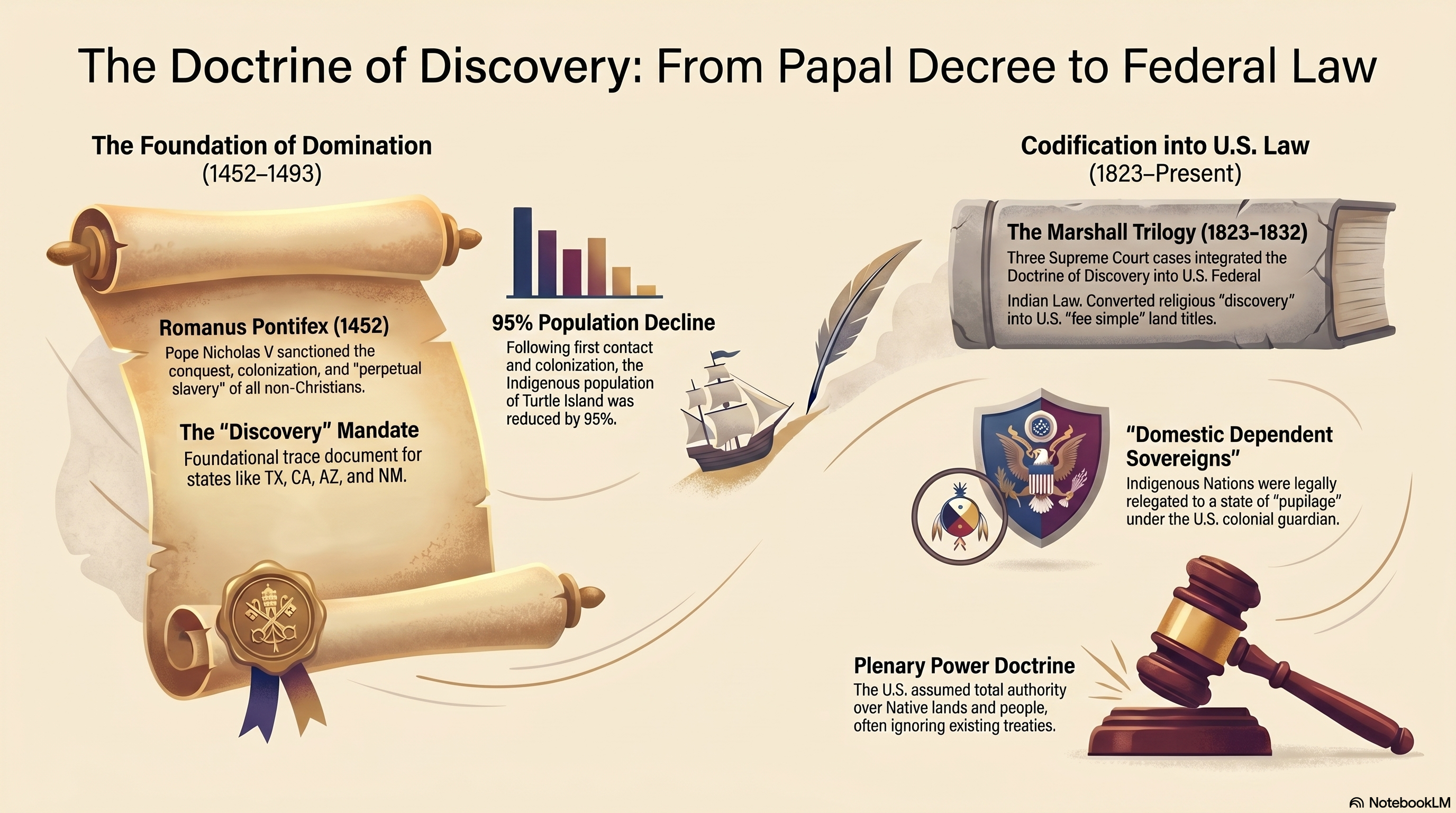
The Foundation of Domination (1452–1493)
- Romanus Pontifex (1452): Pope Nicholas V, writing to King Alfonso V of Portugal, declared war against all non-Christians throughout the world — directing the king to "capture, vanquish, and subdue the Saracens, pagans, and other enemies of Christ," to "put them into perpetual slavery," and "to take all their possessions and property." Supporting bulls were reissued in 1455, 1456, 1481, 1493, 1506, and 1514.
- Inter Caetera (1493): Pope Alexander VI purported to "give" to Ferdinand and Isabella all lands Columbus had "discovered" or would discover, desiring that non-Christian nations be "subjugated" and made Christian in the spread of the "Christian Empire."
- The "Discovery" mandate in US Organic Law: the 1493 Papal Bull serves as a trace document to the founding of nine states — Texas, New Mexico, Arizona, California, Nevada, Utah, Colorado, and parts of Idaho — plus many states carved from Spanish-controlled Louisiana Purchase lands.
- 95% population decline: following first contact and colonization, the Indigenous population of Turtle Island was reduced by 95%.
Codification into U.S. Law: The Marshall Trilogy (1823–1832)
- Johnson v. M'Intosh (1823): because Native Peoples were not Christians, the Court treated the continent as unoccupied — "terra nullius" — and subject to "discovery" by Christian nations of Europe, converting religious "discovery" into the colonial claim of fee simple absolute title over all Native territory.
- Cherokee Nation v. Georgia (1831): Native Nations were declared "domestic dependent sovereigns" in a state of "pupilage" — the root of today's "trust doctrine," relegating Nations to the will of their colonial "guardian."
- Worcester v. Georgia (1832): the United States assumed absolute "plenary" power over Native nations, lands, waters, resources, governance, religion, and even children — authority the Court still applies, as recently as McGirt v. Oklahoma (2020). Later cases such as Tee-Hit-Ton (1955), Oliphant (1978), and Nevada v. Hicks (2001) carried the doctrine forward — the government's Tee-Hit-Ton brief even cited Genesis and Psalms.
What It Cost the Oceti Sakowin Oyate
- The 1851 and 1868 Fort Laramie Treaties — entered as equal sovereigns after the Oyate defeated the United States in wars of defense — guaranteed its territory and exclusive sovereignty; the 1868 treaty required consent of three-quarters of adult males for any land cession.
- In 1871 Congress unilaterally ended treaty-making with Native nations; in 1877 it ratified a fraudulent "treaty" seizing He Sapa (the Black Hills) and over three-quarters of the Oyate's territory — a theft "legalized" by the Supreme Court in United States v. Sioux Nation (1980).
- The Allotment Act of 1887 and the 1889 breakup of the territory into six smaller reservations took another 9–11 million acres. The Oceti Sakowin Oyate has never accepted these non-treaty takings.
The Letter to the Vatican
The letter is authored by the Oceti Sakowin Oyate — the People of the Seven Council Fires, known to the United States as "The Great Sioux Nation" — through the Oceti Sakowin Treaty Council (Rosebud, SD), drafted in collaboration with allied researchers working from Treaty Council documents, and honoring the scholarship of Steven Newcomb (Shawnee/Lenape) of the Indigenous Law Institute.
Writing to Pope Francis from the Great Plains of Turtle Island — their second communication, following one of May 22, 2018 — the Oyate thanks the Pope for his repudiation of the harmful Papal Bulls, then calls on the Vatican to go further: a full revocation of the Bulls by a new Papal Bull, delivered in formal ceremony with First Nation Indigenous people, together with the overturning of Johnson v. M'Intosh. The letter documents how the Bulls violate international law — the UN Genocide Convention (1948), the Convention on the Elimination of Racial Discrimination (1965), the ICCPR's guarantee of self-determination (1966), and the UN Declaration on the Rights of Indigenous Peoples — and recounts the effects of colonization on the Oyate's economy, language, culture, and sacred sites. As the letter declares, with First Nation relatives across the globe: "We still stand."